
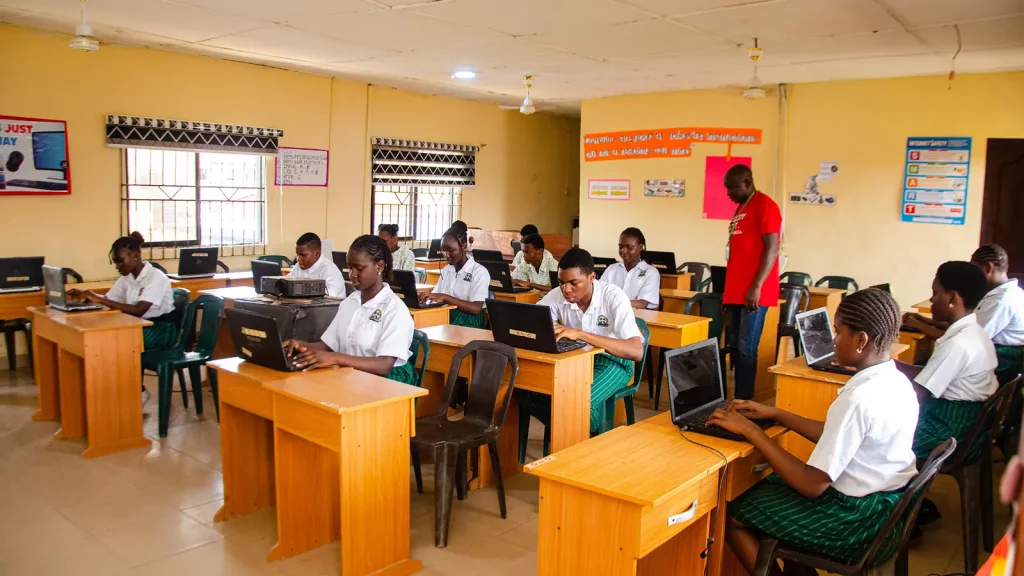
When parents compare schools, they usually ask about results, facilities and fees. A quieter question deserves just as much attention: how many children will share a classroom with your child? The small class sizes benefits that teachers talk about are not a marketing slogan. They show up in the everyday details of a school day, such as whether your child is asked a question, whether their exercise book is marked properly and whether a teacher notices when they go silent.
In this article we look at what research broadly says about class size, why attention and behaviour improve when numbers drop, and how a school can keep classes small in practice. We also explain why Palmville College caps its classes at no more than 25 students.
Small class sizes: what research says
Education researchers have studied class size for decades, and the honest summary is nuanced. Smaller classes do not automatically produce better results on their own. A weak lesson is still weak whether it is delivered to 20 children or 60. However, many studies and education experts point to the same pattern: the benefits of smaller classes tend to be strongest for younger children and for pupils who need the most support.
The reason is simple and does not need a statistic to understand. Teaching is a human activity with a limited supply of attention. A teacher has a fixed number of minutes in a lesson, and those minutes are divided among everyone in the room. When the room has fewer children, each child receives a larger share of questions, feedback and encouragement. Smaller classes also give a good teacher more room to use their skill, because they can vary activities, check understanding and adjust the pace.
The benefits of small class sizes: attention for every student
In a large class, the confident children tend to dominate. They raise their hands first, answer first and get feedback first. The quiet child, the slow starter and the student who is hiding a misunderstanding can pass an entire term without being properly heard.
In a class of 25 or fewer, a teacher can realistically do the things that make the biggest difference to learning:
- Mark written work thoroughly and return it quickly, with comments a student can act on.
- Ask every child questions during a lesson, not only the volunteers.
- Spot confusion early, before a gap in Mathematics or English grows into a bigger problem.
- Give stretch work to students who finish early, and extra help to those who need it.
- Get to know each student as a person, including their strengths, worries and interests.
Better behaviour and participation
Behaviour is closely tied to class size. When a teacher is responsible for a very large group, a large part of every lesson goes on managing noise, seating and interruptions. In a smaller room, small problems are noticed and settled early, often with a quiet word rather than a formal sanction. That leaves more time for teaching.
Participation changes too. Many students, especially teenagers, are reluctant to speak in front of a big audience. With fewer classmates, group discussions, debates and practical work become easier to organise, and a nervous student is more likely to risk an answer. Over time, that willingness to speak up becomes confidence, which is a skill every employer and university values.
What small classes mean for secondary school
Secondary school brings heavier content, practical subjects and national examinations. Laboratory work is a good example. A Physics, Chemistry or Biology practical works best when every student can handle the equipment and see the result for themselves, rather than watching from the back of a crowd. The same is true of technical drawing, where a teacher needs to look at each student’s work to correct it, and of ICT, where each learner needs time on a computer.
Small classes also help in the exam years. A teacher who knows each student’s weak topics can point them towards the right revision, which is far more useful than general advice given to a whole year group.
How we keep classes small at Palmville College
Keeping classes small is a decision, not an accident. At Palmville College, classes have no more than 25 students. That means the school plans its admissions around the number of places in each class rather than filling every available seat. It also means we sometimes have to tell families that a particular class is full.
We believe that is the right trade-off. A smaller group lets our teachers apply our motto, “Patience & Wisdom”, in a practical way: patience to explain a topic again, and wisdom to see what each child needs. If you would like to see a class in action, you can book a visit and judge the atmosphere for yourself, or read more about our secondary school.
Frequently asked questions
Do small classes always mean better results?
Not on their own. Small classes create the conditions for better teaching, but results still depend on the quality of teachers, the curriculum and support from home. They work best when all of these come together.
What is a good class size for secondary school?
There is no single perfect number, but many parents and teachers feel that around 25 students or fewer allows real individual attention. Palmville College keeps its classes at no more than 25.
How can I check the class size when visiting a school?
Ask directly how many students are in the class your child would join, and ask whether there is a fixed maximum. Then look at how many children the teacher actually engages with during a lesson.
Class size is not the only thing that matters, but it shapes almost everything else: how much feedback your child receives, how calmly lessons run and how confident students feel about speaking. When you visit schools, count the desks and watch the teacher. The answer often tells you more than a brochure can.